 EN

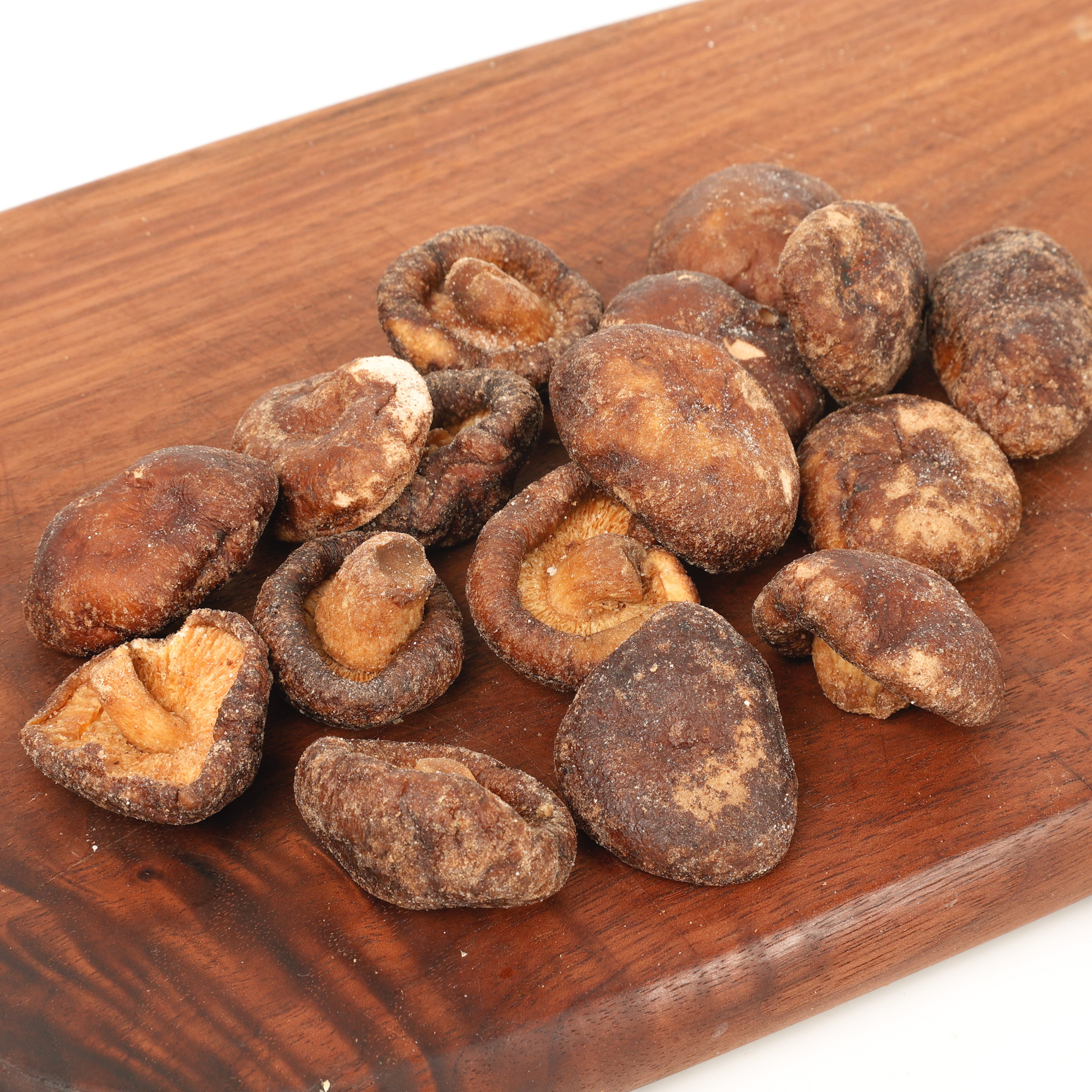
Fresh Shiitake Quality Grading: What Importers Must Evaluate
Fresh shiitake quality is decided at receiving. Importers should inspect visual grade first, then confirm moisture, broken rate, and defect limits before accepting a lot.
Cap size, color, integrity, and gill development as key visual grading criteria
Fresh shiitake caps should be 4–7 cm in diameter with a convex, uniform shape. Caps below 3 cm usually indicate early picking; those above 8 cm risk overmaturity and premature spore release. Color should be a consistent light to dark brown—green, black, or water-soaked patches signal bacterial soft rot or chill injury. Cap integrity is critical: cracks, splits, pitting, and bruising reduce usable yield and create entry points for pathogens. Gill development should show a partially closed to slightly open veil; fully open gills expose the spore-bearing surface, accelerating darkening and shortening shelf life. Use this clear grade table for visual checks:
| Grade | Cap diameter | Cap color | Cap integrity | Gill development |
|---|---|---|---|---|
| A | 5–7 cm | Uniform brown | No cracks or splits | Closed veil |
| B | 4–5 cm or 7–8 cm | Slight variation | Minor bruising ≤5% area | Slightly open veil |
| C | Mixed sizes | Uneven or faded | Visible cracks or soft spots | Open gills |
This visual screen takes less than two minutes per case and significantly reduces downstream spoilage disputes.
Moisture content (90–93%), broken rate (<2%), and defect thresholds per export grade
Fresh shiitake must retain 90–93% moisture. Below 90% causes tough texture and weight loss; above 93% encourages condensation, bacterial growth, and package staining during transit. Export-grade contracts typically require a broken rate under 2% by piece count—caps, stems, and loose gill fragments all count. Total visual and physical defects must not exceed 3% for Grade A, 6% for Grade B, or 10% for Grade C. At receiving, draw a random 1–2 kg sample from multiple cartons and compare it against the pre-shipment photo standard. Calibrated moisture meters should be used on at least five points per pallet. If defects exceed the agreed threshold, issue a non-conformance report before negotiating adjustments—this ensures consistency and minimizes rejection rates.
Food Safety & Regulatory Compliance for Fresh Shiitake Imports
FSMA, GAPs, HACCP, and FSSC 22000 requirements across US, EU, and APAC markets
Importers of fresh shiitake must manage food safety as a multi-jurisdiction control system. In the US, the FSMA (Food Safety Modernization Act) Preventive Controls for Human Food rule requires importers to verify that foreign suppliers implement hazard analysis and risk-based preventive controls. GAPs (Good Agricultural Practices) mitigate pathogen risks at cultivation, harvest, and packing through controlled water use, worker hygiene, and sanitation. HACCP plans identify critical limits for cold holding and cross-contamination from substrate or packing lines. EU buyers increasingly prefer FSSC 22000 certification—a GFSI-benchmarked scheme covering safety management and prerequisite programs. APAC markets often combine local GAP certification with on-arrival inspection; Japan, for example, enforces strict maximum residue limits and mandates one-up, one-down traceability. Without documented controls aligned with these frameworks, shipments risk port rejection or import alerts.
EU heavy metal limits (Cd ≤ 0.15 mg/kg), Prop 65 disclosures, and Certificate of Analysis expectations
The current EU Regulation (EU) 2023/915 sets stricter limits for shiitake than older references: cadmium must not exceed 0.15 mg/kg, and lead must remain below 0.30 mg/kg—significantly tighter than many domestic standards. These thresholds necessitate substrate testing and field-level traceability. California Prop 65 requires clear warnings when cadmium or lead exceed safe harbor levels—even if EU or APAC thresholds are met—because such labels can trigger buyer concern. Importers should therefore source from low-cadmium regions and request a dated Certificate of Analysis (COA) per lot, covering heavy metals, pesticide residues, and microbiological contaminants. Third-party testing strengthens credibility with retail and foodservice buyers. Reject any shipment without a COA that specifies the exact batch and test methods.
Cold Chain Management to Preserve Fresh Shiitake Shelf Life
Fresh shiitake mushrooms are highly perishable, high-respiration cargo. Maintaining a strict cold chain from packhouse to cold storage determines whether the product arrives with firm caps, intact gills, and sufficient shelf life for retail resale.
Optimal storage (36–38°F), breathable packaging, and non-wash post-harvest handling
Maintain continuous storage between 36°F and 38°F (2–3°C). Even brief exposure above 41°F accelerates respiration, weight loss, and cap opening. Use breathable packaging—such as perforated polyethylene or micro-perforated film—to release carbon dioxide and reduce condensation without drying the mushrooms. Keep relative humidity around 85–95%, but avoid free water on caps. Do not wash fresh shiitake after harvest; washing introduces surface moisture that promotes bacterial soft rot. Instead, use dry cleaning, gentle brushing, or air-knife cleaning before packing. Cool mushrooms quickly with forced-air pre-cooling and store them away from ethylene-producing produce to minimize premature gill development and browning.
Early spoilage indicators and realistic shelf-life range (7–14 days) under commercial conditions
Under a stable 36–38°F cold chain, wholesale fresh shiitake typically remain marketable for 7 to 14 days. Reject or downgrade shipments showing slimy or sticky caps, darkening or blackened gills, sour or ammonia-like odors, excessive in-pack condensation, or visible mold at the stem base. Soft, water-soaked spots signal bacterial decay and will spread rapidly in storage. A temperature rise of only 3–5°F can cut remaining shelf life by half—so inspect thoroughly at receiving and enforce strict first-in, first-out rotation. For long-haul imports, plan for 7–10 days of useful retail life after customs clearance, rather than assuming the upper end of the shelf-life range.
Import Logistics, Documentation, and Sourcing Strategy for Fresh Shiitake
HTS code 0709.59.91.00, USDA APHIS phytosanitary certs, and bilingual labeling compliance
Importing fresh shiitake into the US requires classification under HTS code 0709.59.91.00, which covers fresh or chilled mushrooms other than Agaricus. Each shipment must be accompanied by a USDA APHIS phytosanitary certificate confirming the product is free from soil and regulated pests. Commercial invoices and packing lists must match the certificate details exactly. Bilingual labeling—English plus the origin language on cartons—is a practical requirement that reduces customs delays and supports traceability. Importers should verify that suppliers provide a certificate of origin and inspection records before the container departs the port. Missing or inconsistent paperwork remains a top cause of border holds, so documentation review must be a formal step in the sourcing checklist.
Duty implications by origin (China: 12.8%, Mexico/Japan: 0%) and APAC price arbitrage opportunities
Duty treatment varies sharply by country of origin. Fresh shiitake from China faces a 12.8% US import duty, while Mexico and Japan generally enter at 0%, under applicable trade agreements or most-favored-nation terms. This means Chinese product must be priced at least 12–15% lower than Mexican or Japanese supply to remain competitive after landing costs. APAC sourcing still offers price arbitrage when freight and shelf-life risks are managed effectively. For example, $4.00/kg FOB China incurs ~$0.51/kg in duty, yielding a landed cost of ~$4.51/kg before freight. If Mexican supply is $4.70/kg FOB with no duty, the gap narrows quickly. Importers should compare total landed cost, not farm price alone, and consider mixed-country sourcing to balance price, quality, and tariff exposure.
FAQ
What are the key factors to check when assessing fresh shiitake quality?
When assessing fresh shiitake quality, importers should check cap size, color, integrity, and gill development as key visual grading criteria. Additionally, moisture content, broken rate, and defect thresholds must comply with the export grade standards.
What should the moisture content be for fresh shiitake mushrooms?
The moisture content for fresh shiitake mushrooms should be between 90–93%. Lower than 90% results in a tough texture and weight loss, while above 93% encourages bacterial growth and package staining.
What requirements do importers need to follow for fresh shiitake?
Importers must adhere to food safety regulations like FSMA, GAPs, and HACCP standards in the US, as well as FSSC 22000 certification preferred in the EU. Compliance with EU heavy metal limits, California's Prop 65, and traceability documentation are also required for smooth import processes.
What are the optimal storage conditions for fresh shiitake mushrooms?
Fresh shiitake mushrooms must be stored at 36–38°F (2–3°C) with relative humidity of 85–95%. Breathable packaging is recommended, and the mushrooms should not be washed post-harvest to avoid bacterial soft rot.
How long do fresh shiitake mushrooms last under ideal conditions?
Under optimal conditions (36–38°F cold chain), fresh shiitake mushrooms usually last 7–14 days. For long-haul imports, plan for a retail life of 7–10 days after customs clearance.
What documentation is required for importing fresh shiitake into the US?
Importing fresh shiitake into the US requires an HTS code 0709.59.91.00, a USDA APHIS phytosanitary certificate, matching commercial invoices and packing lists, and bilingual labeling (English and the origin language).
Table of Contents
- Fresh Shiitake Quality Grading: What Importers Must Evaluate
- Food Safety & Regulatory Compliance for Fresh Shiitake Imports
- Cold Chain Management to Preserve Fresh Shiitake Shelf Life
- Import Logistics, Documentation, and Sourcing Strategy for Fresh Shiitake
-
FAQ
- What are the key factors to check when assessing fresh shiitake quality?
- What should the moisture content be for fresh shiitake mushrooms?
- What requirements do importers need to follow for fresh shiitake?
- What are the optimal storage conditions for fresh shiitake mushrooms?
- How long do fresh shiitake mushrooms last under ideal conditions?
- What documentation is required for importing fresh shiitake into the US?